



Most Businesses Buy Features They Never Use
When companies evaluate interactive displays, the conversation often becomes a checklist.
4K resolution.
20-point touch.
Android system.
Wireless sharing.
Built-in whiteboard.
The specification sheet grows longer, and the assumption is simple:
👉 More features must mean a better product.
But in real business environments, that assumption is often wrong.
Because the value of an interactive display doesn’t come from how many features it has.
It comes from how effectively those features improve collaboration, communication, and workflow efficiency.
And that’s where many businesses make costly mistakes.
According to research from Gartner, organizations frequently underutilize workplace technology because users struggle to integrate features naturally into daily workflows.
In other words:
👉 A feature only matters if people actually use it.
This guide explains the interactive display features that truly impact modern business collaboration—and which ones matter less than most buyers think.
👉Ultimate Guide to Interactive Displays for Meeting Rooms

The Shift from “Display Device” to Collaboration Platform
Traditional meeting room technology had a simple purpose:
Display information.
Modern interactive displays serve a completely different role.
They are no longer passive screens.
They are collaboration platforms.
This shift changes how businesses should evaluate features.
The important question is no longer:
❌ “What specs does it have?”
Instead, it becomes:
✅ “How does this help teams work better together?”
That difference changes everything.

Touch Technology: The Feature That Changes Meeting Behavior
Touch capability is often treated as a technical specification.
But in practice, it fundamentally changes meeting dynamics.
Without touch interaction, meetings usually follow a one-way workflow:
One person controls the presentation while everyone else watches.
Multi-touch interaction transforms meetings into collaborative work sessions.
Teams can:
- Annotate directly on-screen
- Brainstorm visually
- Edit ideas together in real time
Research from McKinsey shows that collaborative workflows significantly improve decision-making speed and operational efficiency in knowledge-based organizations.
👉 Interactive Display with Multi-Touch Features
The most important factor isn’t simply the number of touch points—it’s responsiveness.
Laggy or inaccurate touch systems quickly reduce user confidence.
That’s why businesses should prioritize real usability over raw specifications.

Wireless Screen Sharing: The Most Underrated Productivity Feature
Many businesses underestimate how much time is wasted connecting devices in meetings.
Searching for adapters.
Switching HDMI cables.
Changing display inputs.
These interruptions may seem minor, but across hundreds of meetings, they create major productivity loss.
Wireless screen sharing eliminates much of that friction.
Modern systems allow users to:
- Share screens instantly
- Switch presenters quickly
- Connect without cables
According to enterprise collaboration studies from IDC, reducing meeting startup friction has a measurable impact on productivity and user satisfaction.
In many organizations, this becomes one of the most frequently used features.

Built-In Whiteboarding: Why Visual Collaboration Matters
One reason physical whiteboards remained popular for so long is simple:
People think visually.
Interactive whiteboarding combines the flexibility of traditional brainstorming with the advantages of digital collaboration.
Teams can:
- Save notes instantly
- Share ideas remotely
- Continue discussions after meetings
This becomes especially valuable in hybrid environments.
👉 Best Interactive Displays for Hybrid Meetings
Instead of losing ideas when a meeting ends, discussions become persistent and shareable.

Camera and Microphone Integration: The Hybrid Meeting Requirement
Hybrid work permanently changed meeting room expectations.
Today, a meeting room is no longer limited to people physically present.
This makes integrated conferencing features increasingly important.
Displays with built-in:
- Cameras
- Microphones
- Speaker systems
reduce hardware complexity and simplify deployment.
According to Microsoft Work Trend Index findings, remote inclusion remains one of the biggest challenges in hybrid collaboration environments.
Integrated systems help reduce those barriers.
But quality matters.
Poor audio and camera positioning can make hybrid collaboration frustrating rather than productive.

Real-World Scenario: When Features Finally Matched Workflow
A regional engineering company upgraded from traditional projector systems to interactive displays across multiple offices.
Initially, leadership focused heavily on hardware specifications.
But after deployment, employees consistently relied on only a few features:
- Wireless sharing
- Touch annotation
- Video conferencing integration
Interestingly, some highly advertised features were rarely used.
The company eventually realized something important:
👉 The most valuable features were the ones that removed friction from everyday collaboration.
Meetings became faster to start.
Brainstorming became more interactive.
Remote participation improved significantly.
👉Interactive Display Solutions
The success wasn’t driven by technical complexity.
It came from simplifying collaboration.

Operating Systems and Software Ecosystems
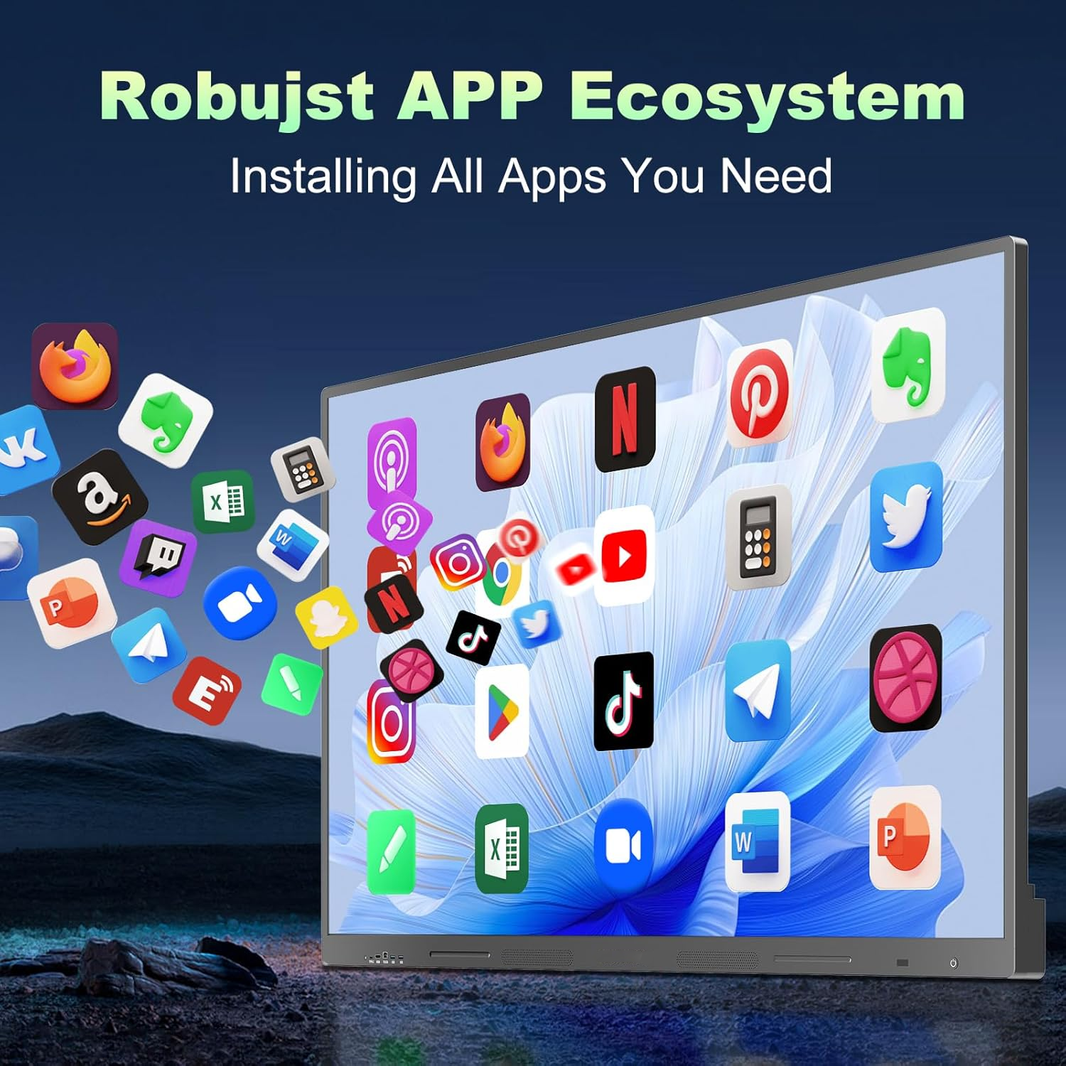
Many interactive displays now include built-in operating systems such as Android.
This allows businesses to run apps directly on the screen without external PCs.
While convenient, software ecosystems should be evaluated carefully.
Businesses should consider:
- Compatibility with existing tools
- Security updates
- Ease of management
In enterprise environments, reliability and compatibility are often more important than having dozens of apps available.

Remote Management and IT Control
For organizations deploying multiple displays across locations, remote management becomes essential.
IT teams increasingly look for features such as:
- Remote diagnostics
- Firmware updates
- Device monitoring
These tools reduce maintenance complexity and operational downtime.
According to Gartner, centralized device management is becoming increasingly important as collaboration ecosystems scale across enterprises.

Display Quality: Important, But Often Overemphasized
Image quality still matters—especially in professional environments.
Brightness, resolution, and anti-glare technology improve visibility and comfort.
But many businesses over-prioritize display specifications while ignoring workflow usability.
A slightly lower specification device that employees use effectively often delivers more value than a feature-heavy system nobody enjoys using.

Security Features Are Becoming More Important
As meeting room systems become increasingly connected, security risks also increase.
Modern businesses should evaluate:
- User access control
- Network security
- Firmware update support
Especially in enterprise and industrial environments, secure collaboration infrastructure is now a critical requirement—not an optional feature.

The Bigger Trend: Features Are Converging Into Simplicity
One interesting shift in the industry is that interactive displays are becoming less about adding features—and more about simplifying experiences.
The goal is no longer:
❌ “How many tools can we add?”
The goal is:
✅ “How seamless can collaboration become?”
This is why the best meeting room technology often feels invisible during use.
Teams focus on discussion—not troubleshooting.

The Best Features Are the Ones Teams Use Naturally
It’s easy to get distracted by technical specifications.
But successful businesses evaluate interactive display features differently.
They focus on:
- Collaboration efficiency
- Ease of use
- Reliability
- Workflow integration
Because at the end of the day, the purpose of meeting technology is not to impress people with features.
✅ It’s to help teams communicate and work more effectively.
👉 Looking for an interactive display built for real business collaboration?
Leave a comment