



Introduction: The Wrong Question Most Buyers Ask
When companies start researching interactive displays, the first question is almost always:
“How much does it cost?”
But in real-world B2B environments, that’s rarely the question that determines success.
A better question—and the one experienced buyers ask—is:
👉 “How long will it last, and what value will it deliver over time?”
Because unlike consumer electronics, interactive displays are not short-term purchases. They are part of a company’s collaboration infrastructure, often used daily across multiple teams.
And that changes everything.

So, How Long Do Interactive Displays Actually Last?
In most business environments, commercial-grade interactive displays typically last between 5 to 8 years, with many extending beyond that when properly maintained.
This aligns with broader enterprise hardware lifecycle benchmarks. For example, lifecycle studies from organizations like Gartner suggest that most workplace IT hardware is replaced on a 5–7 year cycle, depending on usage intensity and technological relevance.
What’s important to understand is that displays rarely “fail suddenly.” Instead, they gradually degrade in ways that affect usability:
- Brightness slowly decreases
- Touch response becomes less precise
- Software compatibility begins to lag
This predictable lifecycle is actually a benefit—it allows businesses to plan upgrades strategically instead of reacting to failures.

What Really Determines Lifespan?
Not all interactive displays age the same way. In practice, lifespan is influenced less by time and more by how and where the device is used.
A display in a standard meeting room used a few hours per day will last significantly longer than one running continuously in an industrial control environment.
Hardware quality also plays a major role. Commercial-grade panels are designed for sustained usage, unlike consumer TVs, which are not optimized for long daily operating hours.
Even installation method has an impact. Stable setups tend to reduce long-term wear and accidental damage.
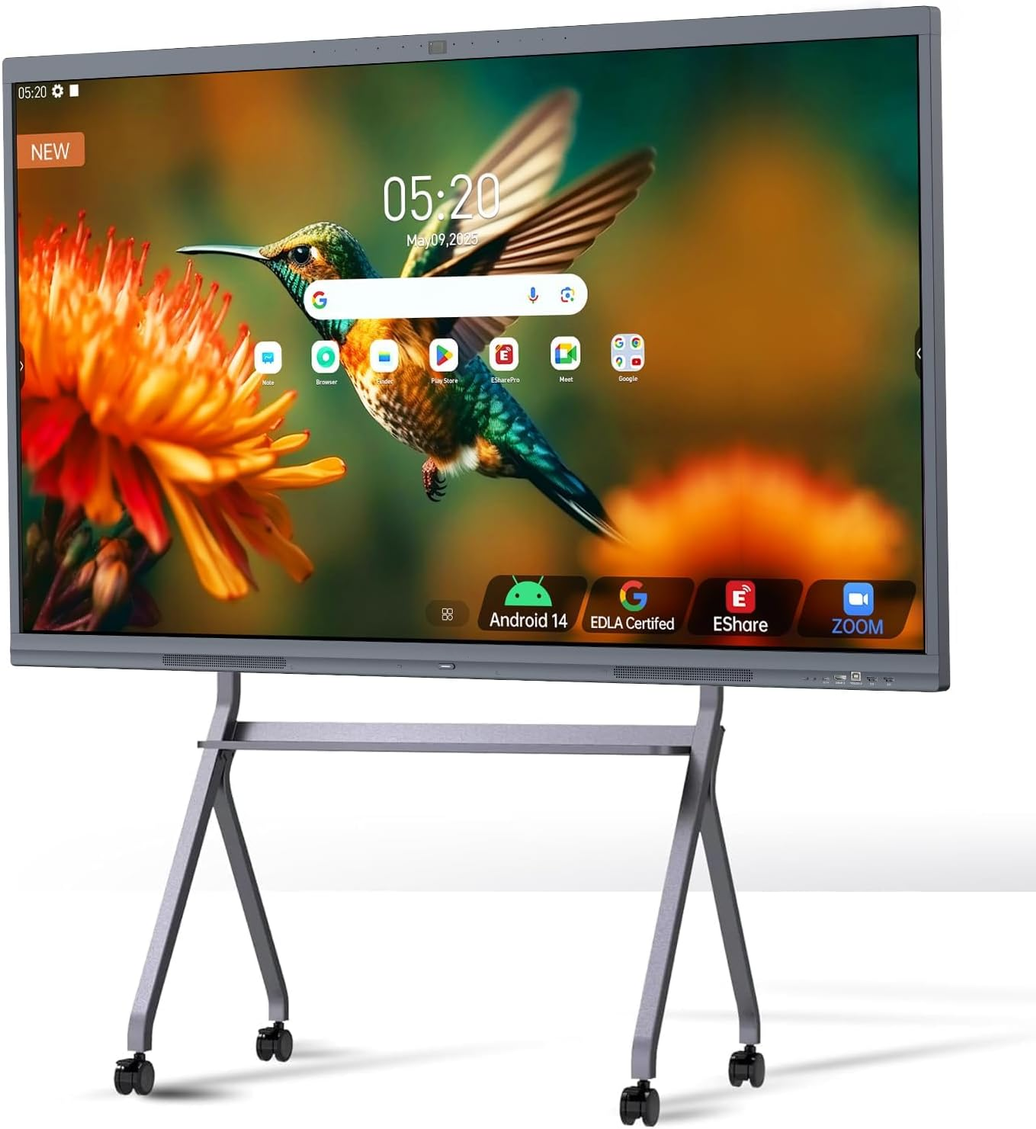
👉 Wall Mounted vs Mobile Stand
Environmental factors—such as dust, temperature, and ventilation—also quietly shape longevity, especially in industrial settings.

Cost vs Value: Why Upfront Price Is Misleading
One of the biggest misconceptions in display purchasing is equating price with cost.
In reality, businesses should be evaluating Total Cost of Ownership (TCO)—a concept widely used in enterprise IT decision-making.
According to research from IDC (International Data Corporation), organizations that evaluate technology based on TCO rather than upfront cost tend to achieve significantly higher long-term ROI.
When applied to interactive displays, TCO includes:
- Initial hardware investment
- Maintenance and replacement costs
- Time saved during meetings
- Reduction in separate tools (projectors, whiteboards, conferencing systems)
This is where interactive displays begin to outperform traditional setups.

Why Interactive Displays Often Deliver Higher ROI
Compared to projectors or fragmented meeting setups, interactive displays consolidate multiple tools into one system.
That consolidation has measurable effects.
For example, workplace productivity research from McKinsey has shown that improving collaboration efficiency can increase productivity by 20–25% in knowledge-based work environments.
While not all of that comes from hardware alone, interactive displays play a key role by:
- Reducing meeting setup time
- Enabling real-time collaboration
- Eliminating friction between tools
Over time, these small efficiency gains compound into significant operational value.

A Real-World Scenario: From Cost Concern to Measurable Value
A regional engineering company offers a useful example.
Before upgrading their meeting infrastructure, they relied on a mix of projectors, whiteboards, and standalone conferencing tools. On paper, the system worked—but in practice, it introduced constant friction.
Meetings rarely started on time. Teams spent several minutes connecting devices, adjusting displays, and switching between tools. Engineers struggled to explain complex diagrams without interactive capabilities, and remote collaboration remained inefficient.
Initially, management hesitated to invest in interactive displays because of the higher upfront cost.
Instead of rushing the decision, they ran a controlled rollout:
- Interactive displays were installed in key meeting rooms
- Mobile units were introduced for flexible collaboration
👉Interactive Display Solutions
The transition required some adjustment. Teams needed basic training, and workflows had to evolve to take advantage of real-time annotation and content sharing.
But within a few months, the impact became clear.
Meetings started faster. Discussions became more visual and interactive. Most importantly, teams were able to resolve issues more quickly—especially when collaborating across departments.
When the company reviewed performance after one year, they found:
- Meeting setup time reduced by several minutes per session
- Collaboration improved across engineering and operations
- Maintenance costs dropped due to fewer separate devices
Based on internal estimates, the investment reached break-even in under two years.

How to Think About Value as a Buyer
For businesses evaluating interactive displays, the key is to shift perspective.
Instead of asking:
❌ “Is this display expensive?”
Ask:
✅ “What does this cost me per year of use?”
✅ “How much time does this save my team?”
✅ “How many tools does this replace?”
This mindset aligns with how enterprise buyers evaluate infrastructure—not as a purchase, but as a long-term productivity asset.

Extending the Lifespan: What Actually Works
Maximizing lifespan doesn’t require complex maintenance. In most cases, it comes down to a few practical decisions:
- Choosing the right installation setup
- Ensuring proper ventilation
- Keeping software updated
- Avoiding physical impact or misuse
👉Installation Guide
Small decisions like these can extend usable life by years.

Why Businesses Are Moving Toward Long-Term Display Investments
The shift toward interactive displays is not just about technology—it reflects a broader change in how companies think about collaboration.
As hybrid work, cross-functional teams, and real-time decision-making become standard, organizations are investing in tools that support continuous, efficient interaction.
Industry data consistently shows that companies adopting integrated collaboration systems experience measurable gains in productivity and alignment.
Interactive displays are increasingly becoming part of that foundation.

It’s Not About Cost—It’s About Value Over Time
Interactive displays are not the cheapest option upfront.
But they are rarely meant to be.
They are designed to deliver value over years of use—through better collaboration, faster decision-making, and reduced operational friction.
And when evaluated through that lens, the question is no longer:
👉 “How much does it cost?”
But:
👉 “How much value will it create over its lifetime?”
Leave a comment